
Tannery includes processes such as immersion, fleshing, depilation, liming, deliming, degreasing, softening, pickling, deacidification, chrome tanning, dyeing, drying, and finishing. Different processes use different feeds and solvents, resulting in wastewater containing various pollutants.


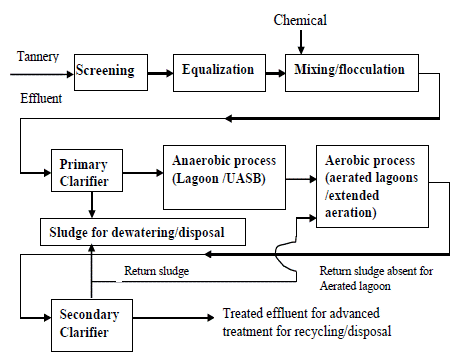
Characteristics of tannery effluent treatment
Tannery includes processes such as immersion, fleshing, depilation, liming, deliming, degreasing, softening, pickling, deacidification, chrome tanning, dyeing, drying, and finishing. Different processes use different feeds and solvents, resulting in wastewater containing various pollutants. Tannery effluent is mainly produced in the preparation of sputum, tanning and other wet processing sections. The most polluting is degreasing wastewater, liming depilatory wastewater, chrome tanning wastewater.
Tannery effluent treatment process
S1: PH Adjustment. Collecting tannery wastewater, adjusting the pH of the wastewater to 2.5~ 3 under stirring;
S2: Add FeSO4·7H2O. The amount of Fe2+ added is 1~100g/m3 of the amount of wastewater, which can mainly reduce Cr6+ to Cr3+;
S3: Multiphase pole coupled electrochemistry. The Tannery effluent is discharged into a multiphase pole-coupled electrochemical device for 2 hours to remove COD and various organic compounds in the wastewater.
S4: Solid-liquid separation. Wastewater after multiphase pole coupled electrochemical purification passes through solid-liquid separation device. Thereby, the solid particles inherent in the wastewater and the solid particles produced by the reaction in step S3 are removed.
S5: A2/O, Anaerobic and aerobic.
Requested Information before Quote
| Raw wastewater Quality | |
Wastewater source | |
Treatment Capacity | |
COD (mg/L) | |
BOD (mg/L) | |
SS (mg/L) | |
Ammonia (mg/L) | |
Phosphorus (mg/L) | |
Other Values | |
Treated Water Quality /Discharge Standard | |
COD (mg/L) | |
BOD (mg/L) | |
SS (mg/L) | |
Ammonia (mg/L) | |
Phosphorus (mg/L) | |
Other Values | |